The paint
A substance,
not a colour.
Most painting apps treat paint as colour with a texture on it. I wanted to treat it as matter: something with volume that the brush carries and runs out of, that mixes the way pigments do, and that is wet, then dry. Anything that broke that would be a lie you'd feel as a painter, even if you couldn't name it.
A perfect mixer that blends evenly and instantly feels fake, even with the right colour.
Getting blue and yellow to make green is a solved problem. Getting them to marble, streak and dirty the brush the way paint does is where natural paint lives, so that's where I spent the simulation's effort.
What paint is
- It has volumeIt runs out. A spent brush moves the paint already on the canvas instead of adding more.
- A brush holds it in two placesOn the outside of the bristles, which comes off first and thick, and in the belly, which feeds a long thinner stroke.
- It holds its shapeBelow a certain force oil paint doesn't flow, so a peak stays a peak.
- It mixes as pigmentsBlue and yellow make green because each absorbs what the other reflects. Titanium white bullies everything it touches.
- It is wet, then dryInto wet paint a stroke drags the colour below with it; over dry paint it sits on top.
What I decided
Every spot on the canvas holds an amount of paint
The canvas is some two million cells, and each holds how much paint is there, in a wet and a dry layer, not only what colour it is. Paint piles up, keeps its height, and can only hold so much, so when you paint over a passage you build it up rather than stacking without end.
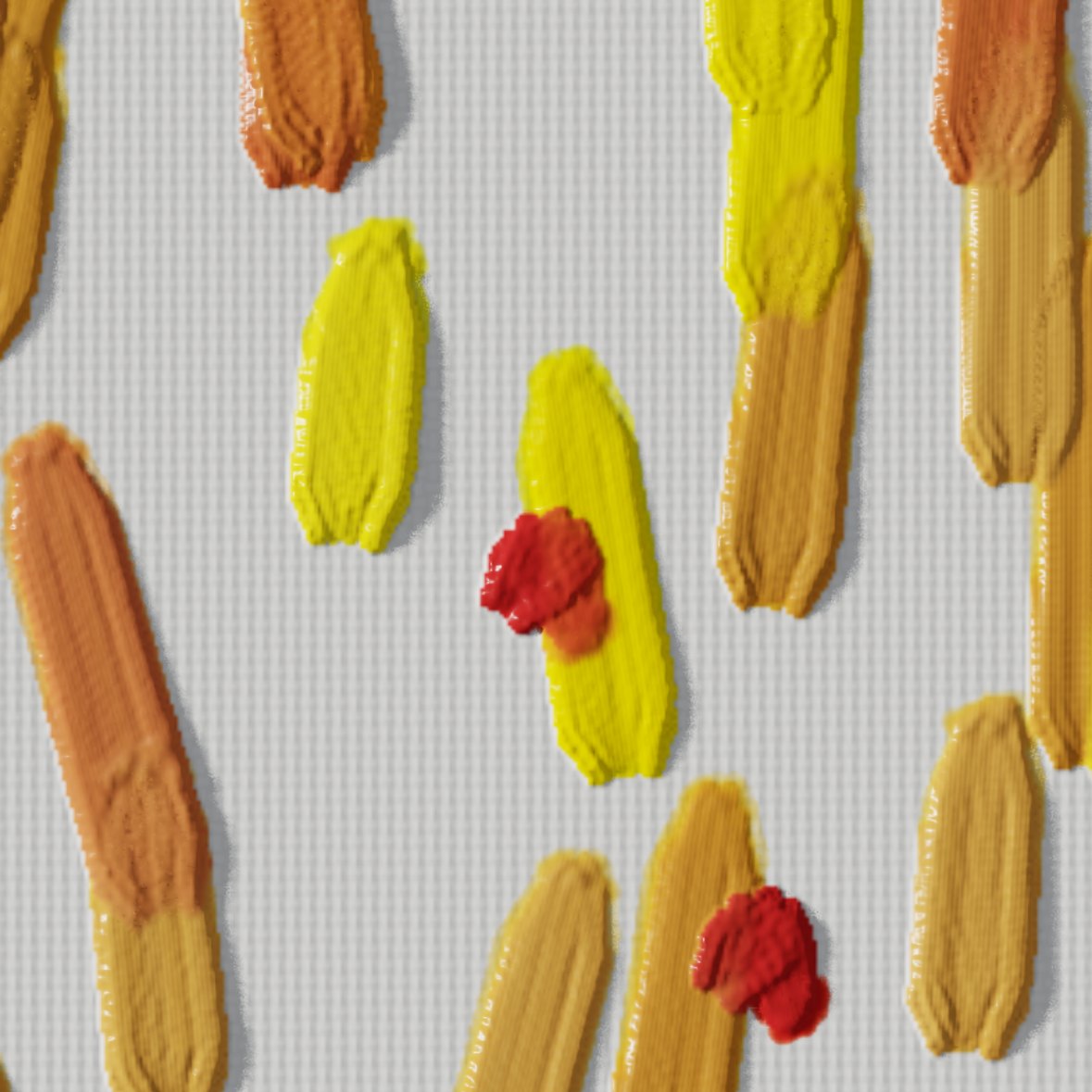
A brush that carries paint, lays it on, and runs dry
Every bristle has two stores: surface paint that comes off readily and belly paint fed out more slowly, more when you press or slow down. A loaded flat squeezes paint out at its sides and leaves a lip where it lifts. As it runs dry it stops adding paint and starts dragging what's there.
At first you had to tap for more paint every few strokes. When I painted with it, that just didn't feel intuitive: a real painter dips without thinking. So now every stroke starts with fresh paint, and the new paint joins what the bristles still carry, as dipping a real brush does: a colour the brush went through on the canvas tints the next stroke or two, then clears. Tap the selected mix again and the brush is clean at once.
Eight named pigments, mixed by how they treat light
Titanium white, yellow ochre, cadmium red, ivory black, ultramarine, cadmium yellow, burnt sienna and burnt umber, each a curve of how it absorbs and scatters light across the spectrum. A mix is worked out from those curves (the Kubelka–Munk model), and I check it against real paint on every change: ultramarine and cadmium yellow make green, complements dull each other, umber is darker than sienna.
I added the earths because my robot painter, driving the app's own brushes through sixteen paintings, kept missing deep warm darks that six bright pigments can't mix.
A palette is where colours are kept
A mix is a recipe in parts, the way painters talk about one: each tap on a pigment adds a part, strong into weak, a little at a time, and the mix shows its recipe. Because it's a recipe, not a sample, dirt on the canvas never spoils it, and you can load it again, pure, as often as you like. Tap the wrong colour and undo takes the part back. The real mixing happens where it does for a painter: on the brush and on the canvas.
Ruled out: a separate dish to mix in. It worked, but it took room from the painting for something the canvas already does.
Wet while you work, dry when you glaze
Paint stays wet while you work it, so colours drag into each other. Tap Dry, or come back to a painting after a long break, and it has dried: new paint then sits on top as a separate film, so a thin layer glazes and scumbles over what's beneath instead of mixing into it.
Each tool does what its real one does
Nine brushes from a broad flat to a hair-thin rigger; a knife that lays a flat plane that shines; and a rag, which lifts wet paint and smears only a little of what it carries. I took out the finger as a tool: the mop does its soft blending, and one less thing to choose made the brushes clearer.
What oil paint does that Enogu doesn't, yet
The knife still lays a brick-shaped slab rather than paint pushed off its loaded edge. A cool red, a cool blue and a lemon yellow would widen the palette. And I'd like mediums beyond a single stiff-to-oily setting.
How brushes and knives hold paint What makes mixing feel natural The robot painter